Updated on 09/21/22
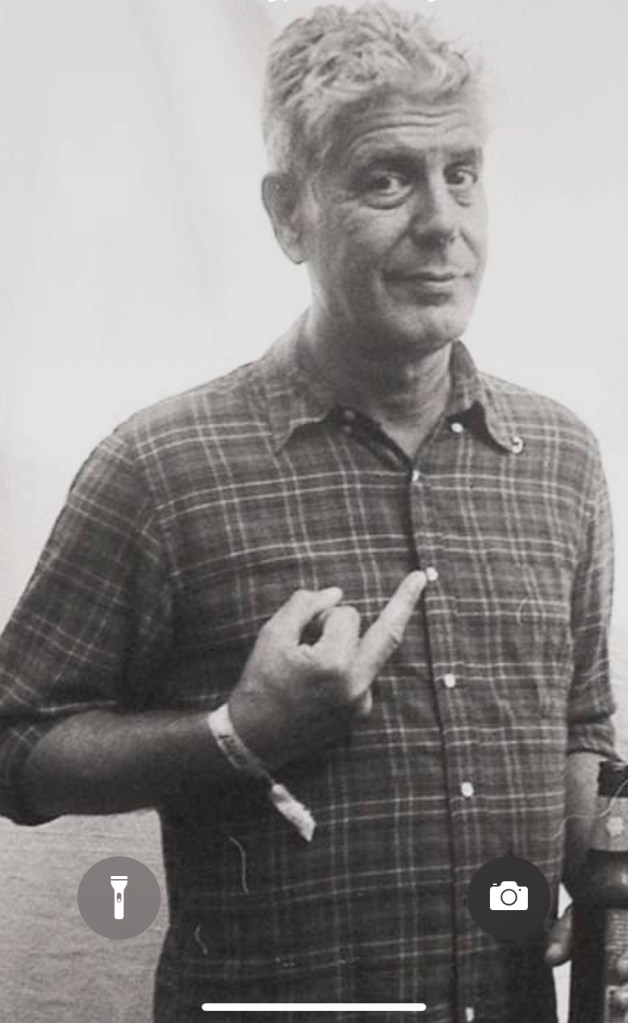
Anthony Bourdain crosses my mind every goddamn day. He’s even eternally flipping me off on my phone’s home screen as a constant reminder for me to be actively growing, and morphing into a better person as much as I can with what I have.
The Food Network and Travel Channel were staples in my household growing up. I caught my mom watching an episode of No Reservations one evening, and I was hooked. I think what dragged me in at first was that Bourdain never looked like a chef, or even your run-of-the-mill television host. He had that arrogant rock star quality to him (I mean, let’s be honest. His shows were a form of self fulfillment, and the arrogance kept us watching) with a somewhat unexpected genuine humbleness that he honed over the years. What was even better was that he was forming opinions about people and places and having those ideas broken down and destroyed right in front of the camera from the very start. He not only advocated for open-mindedness, but practiced it as well. Most importantly, he was breaking down barriers between different communities all over the globe. He was sitting down with regular people in their home countries, eating their food while making authentic connections, and I think in turn making those of us watching less afraid of the unfamiliar. He was not only teaching me to embrace differences, but showing me how to travel, and letting me know that if I wasn’t eating what the locals were, I was missing out on an aspect of worldly experience. Even if I didn’t venture far from my own hometown in Texas I could still try new things, and had my fair share of moments of clarity where I was the only white person in the room eating a damn fine meal that involved dishes my palate wasn’t fully familiar with. Things as simple as ponche navideño (the first time I ever tasted guava) and mole, to the more adventurous chapulines, were given to me in hospitality and warmth. While on one occasion I ate some menudo that gave me severe heartburn, I had no regrets about spooning every last drop of it into my mouth. (Yes, tripe and all.) I’m forever thankful for these experiences, as well as the people who welcomed me into their homes and shared their food. They certainly are moments I think back on fondly, especially when I need reminding that the world really is a vast and beautiful place.
My relationship with food hasn’t always been a healthy one. As an adolescent, I had a terrible eating disorder. Like any teenager I was self-conscious of my body, but this had nothing to do with that. I was not on the verge of anorexia nor was I pencil thin. I wasn’t consciously or purposefully trying to shed weight. I simply had eating anxiety. Eating is usually a social activity. I was/am a shy person. It isn’t a good combination. Lunch was the worst part of my day in high school. I hated lunch hour. HATED IT. By the time I was a senior, I didn’t even care that I had run out of lunch money before the end of the year. Like a mouse, I lived off of Ritz Crackers and cheese slices I had brought from home for a month. They were easy to eat, and I could do it quickly. Perfect and inconspicuous. I didn’t even have to mess with utensils! College wasn’t much better. I was hardly ever in the dining hall unless some peers coerced me into going. By that time I didn’t mind being invited to eat something, because it certainly felt good to be included in a new environment, but I still had this anxiety. It was never as pleasant an experience as it should have been. It wasn’t until I got older that I realized it wasn’t just the social aspect of eating that made me feel anxious, but the vulnerable, and somewhat sexual, feeling eating gives you. Mukbangs anyone? Why do you think people pay these Korean girls to eat massive meals on video for the pleasure of the person hidden behind the screen? Why do food critics use sexual metaphors in their reviews? Why is the eggplant emoji the symbol for you know what? The term “food porn” speaks for itself. And Ortolans??? Come on. . . There’s a reason you cover your face with a cloth while you crunch on one of France’s most delicate little birds, bones and all. Watch this clip from No Reservations as Tony has a near orgasm waiting for a bowl of pho. . .
Food is sexy. Eating is sexy, or at least society likes to think so. If you really step back and take a more logical view, we all look really weird when we’re chowing down. Why do people feel fine sitting at a bar next to a stranger, but not in a restaurant? Because we feel vulnerable when we’re eating with people we don’t know. It’s like we’ve taken our clothes off in front of them. I still deal with eating anxiety on occasion, but for the most part that anxiety has bled over into my cooking and is contained there. (I accidentally started a small fire while cooking chicken once, and I haven’t fully recovered.) While I’m not terrible in the kitchen, I’m incredibly nervous about making food for people. I want to keep all the accidental fires, undercooked meat, and mediocre dinners to myself and not subject them to anyone else. Since I’m no longer hindered by the social aspect of eating, it makes me pause and think about what changed. College helped (although in limited ways). A desire to try new things and stop being so afraid also helped when I realized I could use food as a sort of gateway to accomplish those feats. Asian food helped. Name a restaurant you’ve felt more welcome in that isn’t Asian inspired? Well. . . maybe you can, but I certainly can’t. Even the sushi chef at H-E-B greets me with a warm hello, and an acknowledgement of remembrance when I stop to pick up my bi-weekly grocery store sushi dinner, which I assure you isn’t as bad as that description makes it sound. There’s something about Asian cultures wanting to share their food with us that makes it familiar even when it’s not. I realize there’s still a gap between what is served in Asian restaurants today, and what is “authentic”, but you get my point. I remember riding the “T” in Boston a few years ago. I was squished into that subway car like a sardine (I don’t think I have ever written something that is so glaringly pre-COVID) next to a woman close to my age, and an older Asian man. I couldn’t help but eavesdrop on their conversation. Apparently he ran a restaurant she frequented that was close to her apartment, and this sparked a friendship. It seemed both wonderfully unlikely, and beautifully logical.
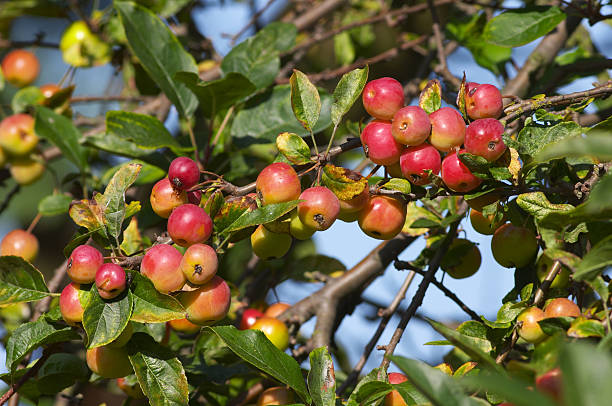
One of the first foods I remember gorging myself on was crabapples, as well as the crabapple jelly my grandmother would make each year. Gran and Paup had a tree in their front yard, and as soon as those little guys were ripe, you could find me perched on an interior branch among the leaves with a scattering of small cores on the ground below me. The only tell-tale sign that I was probably up in the tree, and had been for a while. I liked crabapples because they were tart, and also small. It was like eating an apple without the noise. When I sat in the branches, I could also be hidden while I ate. Without anyone to watch me I was no longer afraid to eat to my heart’s content. There was something primal about it too. I was eating with my hands, barefoot, and sitting in a tree. You don’t get to do that very often. When we dine we have to be clean-cut, sit at a table, and use utensils most of the time. These social rules make it feel like you’re cutting off the instinctual aspect of eating. Maybe that’s why I revel in dishes you eat with your hands. The fact that eating seems to have become too influenced by luxury, foodie culture, and societal standards makes me feel redundantly weird about something we all need to do to survive. Celebrity chefs haven’t helped this matter either. Famed Roman historian, Livy, made the claim that once a society’s elite class amasses so much wealth to allow for a cook to become famous, it also allows for those members of the elite to hoard their money at the expense of the lower classes. Doesn’t that sound uncomfortably familiar these days?
Bourdain has also influenced my interest in seafood. Specifically in the episode of Parts Unknown with Sushi Chef Masa Takayama where they take a stroll through Kanazawa’s Fish Market:

I don’t want just any seafood either. I want unbelievably fresh, open market stuff. I want to suck the meat out of a crab leg that was alive no more than an hour ago. I want to try eel liver that was roasted right there in front of me. I want oysters, and to have no doubt about their freshness. Growing up, and discovering I had an allergy to freshwater catfish, I’ve been less adventurous when it comes to the bounty of food found in rivers and oceans. When I was little I couldn’t even be in the same room while Gran fried Paup’s freshly caught batch in her kitchen. I’ve never even had the chance to taste it because there’s a possibility I’d go into anaphylactic shock. (Do I really want to risk my life for a taste of a river bottom feeder anyway?) Perhaps it’s a desire for something I think I can’t have that interests me when it comes to seafood. Also, I periodically dream of uni. Literally. Countless subconscious vignettes featuring that golden yellow sex organ of the sea urchin that looks like a soft tongue and is said to taste like butter. Living so far inland makes me wary of finding and dining though. However, if I find myself in a seafood market one day you can hand me that uni, I’ll eat it right out of the carcass, but someone should be at the ready to stab me in the thigh with an epi-pen if needed. (As of summer ’21 I have now slid some uni down my gullet! Not as fresh as I would’ve preferred, but still a mouthful of delight I found at a revolving sushi place in San Antonio.)
On the other hand, Bourdain made me discover that I was living in a very small world of my own, and still am. People in small towns don’t usually have an affinity for trying new things. They’re big on fast food, or they’d rather go to the same restaurant that’s been around for decades even though their chicken salads look like something you would give an aging cat on their birthday, and the fillets taste like they came out of a Tyson frozen bag. Look, if I want some soggy breaded chicken or fish, I’ll cook it in the microwave myself and then eat it over the kitchen sink like the depression meal it is. They also display signs of a hive mind when it comes to recommending restaurants that aren’t that great in the first place. I blame it on all those little old biddies who like to eat out at restaurants pretending to be upscale, and who enjoy flirting with the proprietor. At this point it’s not about the food, which is mediocre at best, but the attention, and being able to afford to drop at least $15 on a small soup and sandwich plate.
I remember my sister and I having dinner at one of the handful of taquerias in town one evening. We sat down, ordered, and were chowing down on some tortilla chips with house-made salsa while we waited for our food when she turned to me and said, “It’s weird. Looking around this dining room have you noticed that not one person is smiling?” I hadn’t noticed. I was too busy shoveling chips in my mouth to really care about the environment outside myself, but when I looked around the room I realized she was right. What was it? The food wasn’t bad, the wait staff were personable and good at their jobs. Yet, people were eating their enchilada plates with frowns on their faces like it was just a chore. Was it the tedium of small town life that was getting them down? Had they been to this taqueria too many times to get any more enjoyment out of it? Whatever it was, it certainly darkened the atmosphere, and made the meal a little less enjoyable.
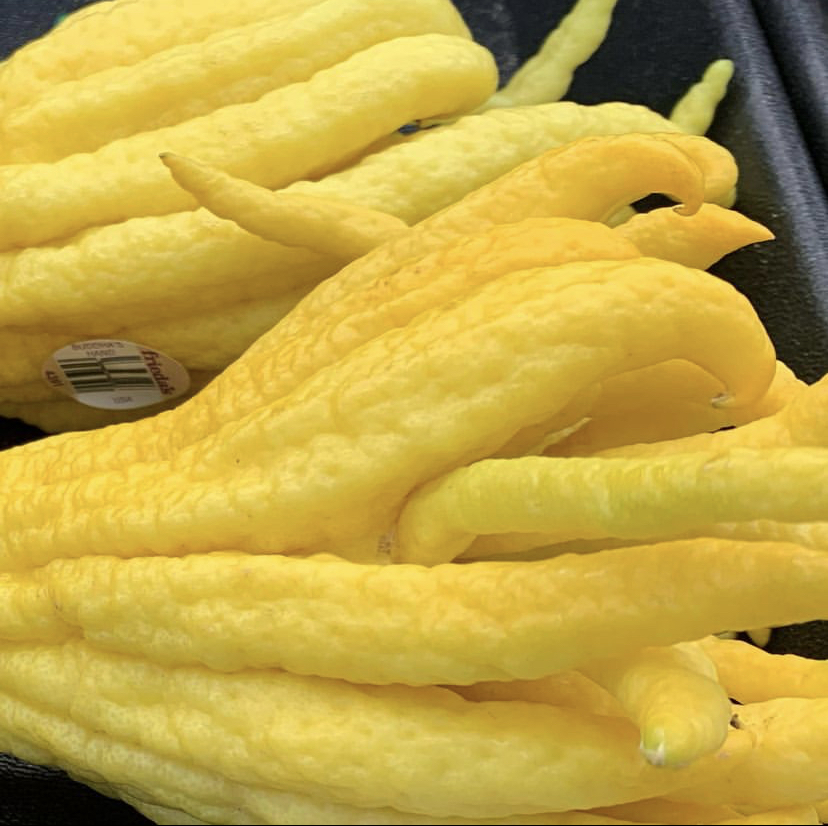
Of course, I’m not trying to say that curiosity doesn’t exist at all in a small town when it comes to food. Our local police force has to dispatch a couple of cops out to direct traffic whenever a new fast food place opens up. . .I wish I could tell you I was joking. . . but on a more positive note I especially notice a desire for new things when at the grocery store. Countless little old ladies have interrupted my shopping to ask me if an item I’ve just picked up is any good. I’ve learned to fib a little and say yes, even if I haven’t tried the product yet. What’s the harm? A few months ago I was engaged in my usual prowl around the produce section when a lady walked up next to me while I was feelin’ up some citrus, and whispered a small “woah” of wonder when she saw the Buddha Hands. She picked one up, and I saw an opportunity while simultaneously using up my monthly quota of extroversion. “Get it”, I said. She asked me what one would even cook with it. I didn’t know, but I told her to worry about that later. “Just get it”, I repeated with a shrug. She took my advice, and walked off with her strange new prize in the toddler seat of her shopping cart. I continued my own shopping, a boost of serotonin running through my veins at the fact that I had been someone’s chaotic cooking angel for a brief moment. I hope she found something good to do with that Buddha Hand. If you’re interested, here’s a few recipes and uses.
Being a native Texan, whether I want to claim that moniker or not (most days I don’t), Bourdain’s Far West Texas episode during Part Unknown’s final season was of special interest to me. Now, Texas is a big state. I haven’t been everywhere even though I live here. Living in South Central Texas I do not come into contact with people who are like those showcased in this episode. The hospitality and open-mindedness when it comes to border politics gave me a little bit of a shock, but in a good way. (I was almost, ALMOST proud to be Texan during those 43 minutes.) Texas Monthly even agreed that West Texans were the “platonic ideal” of Texas residents, and I have to second that.
Ty Mitchell claiming that “loyalty is a big thing in Texas” made me roll my eyes when I first watched this episode. Maybe it is in the West, but it’s not in small areas of South Central. If there is loyalty it surrounds money, and people with recognizably “important” last names. People love gossip no matter who it’s about or where it comes from, and are essentially only out for themselves, but with the help of the mythical lie of Southern Hospitality they easily cover it up, though it always reeks of disingenuousness. You know what’s another big thing in Texas? Egos, and we do not have enough room here to accommodate them all. (I’d like to take this moment to formally apologize to Ty Mitchell. . . he’s right. I ventured to Marfa in January of 2022, and fell in love with the place. I even had a few beers at Lost Horse Saloon, and the bartender was kind enough to take my drunk ass back to my Airbnb at the end of the night, when I was prepared to walk the half mile back. What’s loyalty and friendship, if not that? This whole year has been about some self rediscovery and relearning what it means to be to be Texan. There’s something cosmic in the dust that settles in Marfa, something that makes you feel so big and yet so small at the same time underneath that vast sky, and there are countless examples leading to the understanding that Texas is far more beautiful when she’s bi-cultural. Marfa felt like the Texas I have been searching for my whole life, and I wasn’t even really looking. Ty doesn’t own Lost Horse anymore, but they’re certainly keeping his vision alive. Everyone is welcome to have a beer there, as long as you’re not an asshole. You can feel it as soon as you walk in the place.)
I live in the Hill Country. Not the wide open spaces that most people probably think of when it comes to Texas. There’s a huge gap in income here, because this is a retirement town. You have older generations with big bucks living in the hills, and then there’s the Millennials (and soon Gen Z-ers) who are trying to enter a workforce that doesn’t have room for them. That is, unless they’re in realty, education, or the medical field. I mean, someone has to sell to all these rich retirees, and then take care of them when they’re about to kick the bucket, as well as help to raise the children of people who thought this area would be the absolute perfect place for a kid to grow up. Although sometimes they can come from a long line of money themselves. The trickle down effect only apparent in familial ties. The poverty rate is centered around the middle age to younger female population, and is higher than the national average. Combine that with a lack of things to do, and you’ve got yourself a drug problem, and in turn a crime problem in the community. (Locals and transplants alike seem to be partial to methamphetamines, especially when alcohol ceases to quench their thirst.) The problem is amplified by all of the addiction recovery centers that are matched, and then overlapped by the number of bars we have in a town with a population of a little over 20,000 people. It’s a vicious cycle. While I grew up in this area, and continue to live here (which was never my intention), each day I’m running out of excuses as to why I put myself in this hell. Sure, we’ve got the beautiful Guadalupe River at our disposal (which, when asked about this place and what to do, people usually say “Well, we’ve got a river. . .” and trail off into silence while they grab at straws trying to think of something that makes this place “special”. There are other attractions here, but with all the fumbling and bumbling people have a tendency to do when telling you about them, it’s hard to spark interest), we’ve got views that you really can’t find anywhere else, the stars are in fact big and bright, and perhaps most importantly, this is the birthplace of H-E-B, but nobody ever wants to acknowledge the ugly stuff.
There’s a sort of pastoral idealism that blinds people in this town. There’s a lack of “Southern Hospitality” (I talk about how I think it’s all just a big ol’ myth in this post), it’s hard to find common interests and form relationships, especially for the younger generations (and I am saying this as a Millennial myself), it’s hard to shoot for a career when opportunities are lacking, a lot of people seem to have entitlement issues that make them perpetually rude (if you ever need some concrete evidence on how rudeness begets rudeness look no further than a socially inept small town), and many people have a small mind and overtly conservative and racist world views (one of our current Republican county commissioners once shoved a jar containing an aborted fetus in Bill Clinton’s face outside his hotel while he was in New York for the ’92 Democratic Convention. Seriously, I can’t make this shit up. He also said some unsavory things about George Floyd on his radio show, and yet was elected into office again in 2020). As for cowboys, well let’s just say the ones you find loping around town can’t hold a candle to those West Texas boys, but there are a few who are respectably involved in that old time honored tradition of hunting wild game, but in an ecologically sustainable way. With a client list that includes both Thomas Keller’s French Laundry and Per Se, you’d think these humanely harvested, free-range meats would cost a pretty penny. However, their personal serving sizes are actually affordable if you want to splurge for a special occasion, but you can also occasionally find dishes at local restaurants centered around their venison or quail.
I often hear the refrain, “How did I come from a place so beautiful yet so awful?” from my fellow Millennials when it comes to our hometown. I don’t have an answer, and I’m not sure if gentrification would suffice, because in my lifetime this place has always been a haven for the rich and retired as well as the drug addicted. Sometimes, they’re all the same person. Also, half of these well-to-doers have traveled all around the world, and yet they’re still unapologetically racist. “Travel is fatal to prejudice. . .” My ass. It does nothing for you if you’ve got a narrow mind, and spent all your time in a foreign land with other rich white people. Also, being self aware about your racism does not excuse it. Self awareness doesn’t mean shit if you do not take steps to remedy the faults you find. Besides, this town was built by Charles Schreiner, a wealthy banker with French nobility roots. While he did have to work for his wealth, this town will always have a bitter taste of affluence about it thanks to his legacy whether or not you can see it at first glance because of the quaint façade of small town livin’. Making money and building yourself up in the current climate of the 2020s is a far cry from what it was in the mid-1800s.
I realize progress is not linear, but growing up, and then spending the first decade of your adult years in the same small area allows you to see how much a place has grown, but that’s overshadowed by how insufferably slow the progress has been when it finally started to go in the right direction. I’m constantly being told that my unhappiness has to do with myself, and not my environment. I disagree. In situations you can’t control that encourage negative thinking and anxiety, I find that it slowly chips away at your sanity. Saying that the uncontrollable aspects of an environment I have no choice but to be in on a daily basis has no influence on how I feel invalidates my emotions, and feeling invalid leads to a certain type of repression that will eat you alive. One of my biggest fears is that this place I have to call home at this time in my life is just a microcosm of the bigger picture. I don’t know how I’d be able to handle it if I found that to be true. I keep telling myself that it possibly couldn’t be, but what do I know? I’m not a world traveler, and I haven’t been to more than a handful of places (and never out of the country). My own ideas about the world are probably naïve and erroneous. However, what I do know for certain is that I am a product of my surroundings. Everything from it’s social aspects (or lack thereof), to the education system (including all its failings from Pre-K to college), and now as an adult, and the only thing I have ever felt in return is a sense of being unwanted and undervalued. I have a very warped sense of what it means to be Texan, and in a state whose motto is “friendship” I feel very excluded and out of place. I no longer live a life that allows me to rub elbows with those of different ethnicities and backgrounds like I did when I was younger and in school (a fact that is both sad and frustrating, because I’m at a loss for how to remedy it in an area that is not known for its diversity), and this society I live in is not flexible enough for young people with their own ideas about things. Reverse ageism is real, and I don’t think people can understand that until they find themselves treading water in a sea of Boomers. I find almost nothing more irritating than someone believing that something as minuscule as their age gives them authority, when really most of their advice (which I never asked for in the first place) is completely out of touch.
Oh, and that old Bourdain adage, “Drink heavily with the locals whenever possible” is not applicable here, especially at the bar. If you want what’s good for you, you won’t do it. Trust me. Not only am I a local, but I’ve had enough drinks with other locals to last a lifetime, and all I’ve got to show for it is regret and embarrassment. My lifestyle was immediately elevated when I realized I didn’t give a shit what other drunk people had to say in the bars here nor did I care for their friendship, and stopped going. I know what you’re gonna say. . . “Shelby, you’re being unfair and very close-minded with these blanket statements.” Am I, or am I just breaking down the eccentric and quaint stereotypes of small towns, and it’s a bit soul crushing so it’s making you uncomfortable? Okay, how about this? You go out on the town in the Hill Country one night to mingle with unfamiliar locals, and in the morning you can tell me all about the man with the rotting meth mouth who has an uneducated opinion on everything, the former pill-popper who has found a replacement addiction in alcohol, or if you’re a lady, the middle aged divorced father of too many kids who has tried to hit on you all night despite the fact that you told him no thanks, then gets frustrated and starts to yell at you just to tell you how rude he thinks you are for turning him down. Oh, and guess what! They’ve ALL got an opinion about you (most likely an unfavorable one) and whatever the hell they THINK they know about your life based on what they’ve gleaned from your conversation. You want to find people like this and much worse? Go to the bar. They’re there waiting for you. You want to spend the night in jail, because you made friends with the wrong people? I’ll pick you up the next day. You wanna drink with the locals? Fine. Cross your fingers and hope you get invited to a private residence. Just stay away from the bar unless you’re with a group of friends, and they can buffer you from all the uglies. You know, I really hate writing stuff like this, because I have always wanted to be a person who is open to all different kinds of people from all walks of life, but sometimes the dynamics just don’t mesh with each other. I also think a lack of positive interest in other people is a hurdle not many are willing to climb over in this small town. They’re not interested in why or how you think and do the things that you do, but they are interested in telling you what you should think and how you should do things, especially if they’ve come to the conclusion that you’re wrong. It has happened far too often for me to remain open to individuals like that.
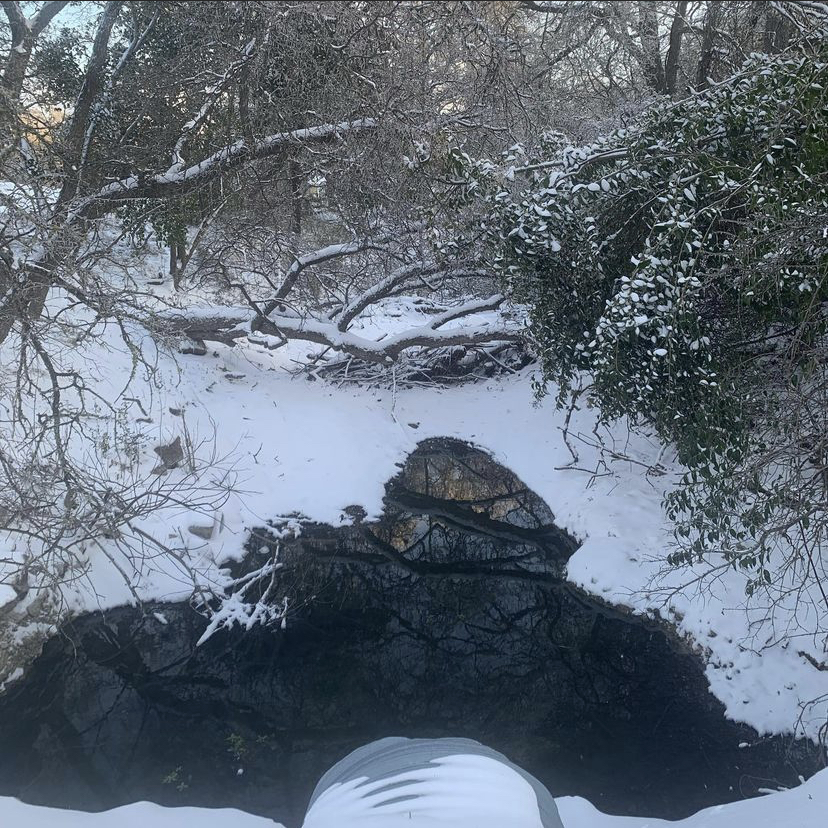
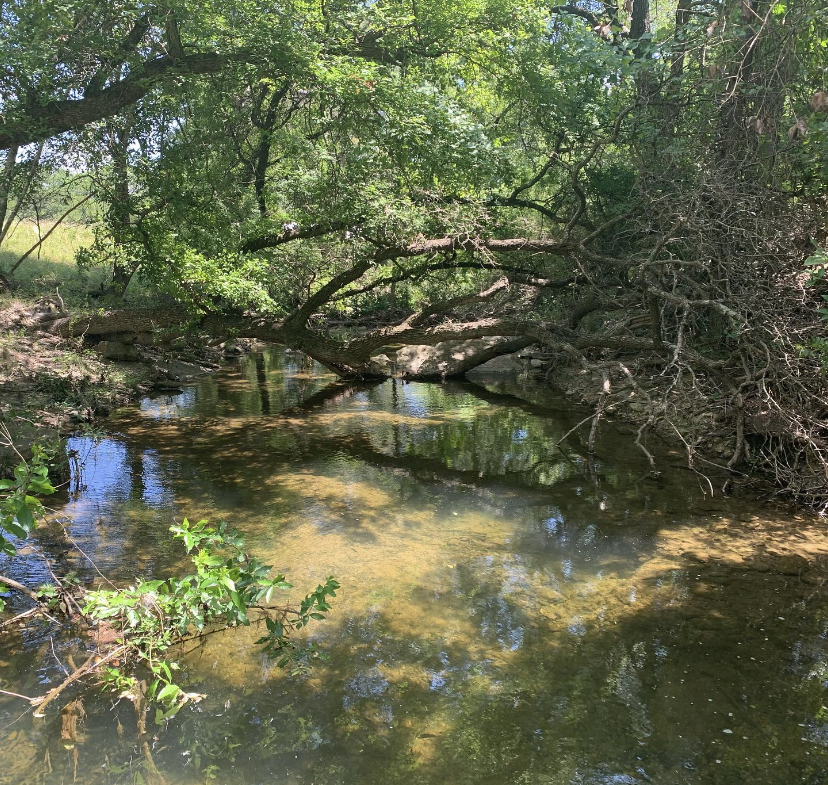
If Bourdain had ever ventured to my hometown for a little R&R I know exactly where I’d take him. The only place where I have ever felt like I could be myself and had a brief moment of happiness, located just down the street from my childhood home. Bumble Bee Creek sounds like a place out of a children’s book, and for a kid who loved animals, and getting a little muddy, it was a bit like nirvana. I would run barefoot on the hot asphalt (I got yelled at for coming home with wet sneakers too many times to care about the blisters on the bottom of my feet that would develop later) down to the creek almost every day during the spring and summer months. Sometimes all that was there was a dry bed due to drought, but on a good day I could trek from one end of the creek that hit the Guadalupe to the other that butted up against private property in the cool water, delighted by the squelch of my footsteps in the mud when I got to the shallower areas. Often, I did not have adult supervision on these explorations, but my parents knew where to find me. It was an idyllic childhood in a sense. I’d see all kinds of wildlife on these journeys. Perch, frogs, crawfish, snakes, deer grazing on the banks if you were quiet enough not to scare them, a wild rabbit once or twice, and I even followed a box turtle from a deep area in the middle of the creek to the mouth at the river one afternoon after I disturbed it by stomping through its home on accident. My favorite were the tadpoles though. Hatching season was the best season, and during droughts I used to try to save the little guys from their ultimate peril by scooping them into a mason jar from the puddles they had been inhabiting, and taking them home. Of course, they never survived long enough in that environment to become frogs, but I felt like I was doing a good deed all the same. I still like to visit the creek every now and then as an adult, although I’m not as quick to stick my bare feet in the mud anymore. For a meal, in this hypothetical Bourdain visit, I’d pack a picnic. Crabapple jelly and peanut butter sandwiches on wheat bread, some sliced and salted radishes, perhaps some cheese (because I know that sonofabitch loved cheese), oatmeal cookies, and a couple of beers, because we’re not at some dirty, lousy bar with sticky counters, and there’s nothing like drinking a cold beer on a hot day near a body of water, no matter how small. Besides, I’m sure if Tony had ventured out to a local bar in my company, and because of his tendency to be opinionated as well as his intimidating demeanor, he would’ve received a glass bottle to the head at some point.*
I suppose I’d be remiss to talk about Bourdain and not mention the elephant in the room. . . So I’m gonna go ahead and put this here: (Please note that the crisis and suicide hotline for the United States has been changed to 988) You can access a list of international hotlines at this link.
I’m not even going to pretend to know what kind of battles Bourdain was fighting. We all deal, and occasionally fail, with depression differently, and the line over the edge is inconsistent from person to person. Some of us don’t even really know where that line falls, and what pushes us over can seem so minuscule to others when they can’t see the bigger issue that’s so personal to us. I’ll let Tony tell the octopus story from the Sicily episode of Parts Unknown for an example (fair warning though, it’s a little hard to watch):
What I can do to try and reduce the stigma surrounding mental health issues is give you a little glimpse inside my own struggle. . .
I was unaware of my own depression for the longest time. I naively felt that my mood would magically elevate at some point in the future. I thought I could just wait it out, but you can’t escape the chemical imbalance of clinical depression which is exacerbated by biological and social factors. I originally thought that I could pinpoint the start of my mental health decline in high school, but I actually think there were signs as early as 5th grade. This was right around the time that my environment stopped being valuable to me and seemed to be hindering all the growing up I needed to do. In South and West, Joan Didion observed, “To be a white middle-class child in a small southern town must be on certain levels the most golden way for a child to live in the United States.” While I don’t disagree with Didion, I don’t think that parents realize that the paradise they wish to create for their offspring is finite. What happens to that child when they grow up? When they realize the world is much bigger than the creeks and solitude that they grew up with? When they realize there’s a nasty duality about people in small southern towns, as well as a false sense of entitlement, and what they’ve been led to believe about good and bad (that’s it’s basically black and white) is actually a gray area they’re going to have trouble maneuvering through as they get older? That the simple life façade that covers their entire existence and everyone else’s does not exist? What happens when critters and childhood friends become disappointments? When they know that the world is so much more beautiful elsewhere and that they’ve been cheated out of a lot of that beauty?
You remember how I thought I was saving those tadpoles by putting them in a mason jar with the lid closed as a kid? My teens were kind of like that. I was a tadpole who had sprouted legs, but had nowhere to go. Had outgrown her environment and in turn was suffocating. I knew that the world was so much more vast than the small sphere I had grown up in. I wanted more, and I wanted to find a place that was more enriching for me. By my senior year of high school, I was ready to go, and go quickly. I submitted applications as soon as I could, and I had a handful of colleges in new and exciting cities I’d been accepted to, and was expecting to get to choose from them. However, when my parents heavily persuaded me to go to the local university, because they held finances over my head by agreeing to help pay for it, and I was not a child who disobeyed her parents very often, I reluctantly enrolled. It was like they had shoved my wanderlust in a box, irreparably crushed my dreams, chained a rock to my ankle, and threw me in the Guadalupe River. While I realize going to college is a privilege (especially when it comes out of your parents’ pockets), the point I’m trying to make here is that the love of a parent and a desire to protect can be detrimental to their children if they don’t watch out. Besides, what did my parents get after shoveling out all those tuition payments? Sure, I have a degree, but at what cost? They not only paid for my education, but my mental health decline as well, and it racked up a bill that included far more than just money. Studies have shown that the wrong college can increase chances of depression. I’ve mentally beat myself up countless times in thinking that I was the only one responsible for my emotions and lot in life (i.e. I should’ve fought harder, I should’ve worked harder, I should’ve been an emotionally stronger person, I should’ve known not to do this instead of that, that I wasn’t smart enough, that I was an incapable piece of shit who didn’t deserve any better), when outside forces had their own impact as well.
Socially, the college I went to did not suit me. I know what you’re gonna say, “Shelby, did you even try to fit in?” Yes. One thing my parents did allow me to do was live on campus. They told me they wanted me to have the “full college experience” which is laughable when I look back on the experience I did have. I was under the (wrong) impression that I would blossom in college. It was a new place with new people (even if it was local), and I believed that I’d finally have the freedom to be myself, and actually find others who shared common interests. While living in the dorms I accepted invites to get togethers (even if I really didn’t want to) in the understanding that it was a necessary component of forming relationships in a new environment, and you know what happened as a result? I got into so much trouble my Freshman year that law enforcement got involved, and that unfavorably clouded the rest of my years there. This was even before alcohol was an influencer in my decisions, and it all stemmed from the mistake I made when I accepted an invite to a cookout from a boy who lived in my building. (Evidence that there are some people out there who you do not want to ever share a meal with.) My peers descended on me like accusatory vultures when someone slashed his tires in the dorm parking lot one night near the end of the spring semester. I was the prime suspect, because this boy and I had had a relationship prior to the slashing, and I had no roommate so I had no alibi. “It’s always the quiet ones” was something I heard talked about constantly through the thin walls and hallways of my dorm room. It was alienating, and incredibly frustrating. These feelings were magnified by the smallness of the institution itself. It didn’t seem to matter to anyone that I didn’t do it, and while the name of the real culprit was on some of their lips as well, (I wouldn’t know the truth until around my Senior year, and as far as I know, this person never suffered any consequences for his actions) they successfully managed to keep him out of harms way by throwing me under the bus. I’m sure they were helped along the way by the smear campaign that’s so common with narcissists, because in hindsight, I did not understand at the time that I was being emotionally abused in that relationship. He not only had my peers fooled, but some faculty and staff as well, so I felt like I had no support system to tell the truth to. I was a quiet, dean’s list student, who had never been in so much trouble before, and I did not know how to handle it, because it seemed like no one was willing to help me. The ordeal made me feel so bad at one point that I could not stand staying in my dorm room some nights and I did not want to spend the night at my parents (lest they ask questions), so I would park my car off campus and sleep in it. I even senselessly feared that my own parents would believe I had slashed those tires in a fit of rage, so they never knew about the incident until years after the fact. Although, perhaps I should’ve told them while it was happening, and that could’ve invited a discussion about transferring schools. I’ll never know, and besides, speaking up was what got me into that situation in the first place, and I wasn’t prepared to do it again with the threat of negative consequences lurking in the background. I chose to socialize and go to that cookout. I chose to say yes to a boy who didn’t deserve it, and he dumped me after I brought up his lack of respect for me. I was trying to stand up for myself, and I suffered greatly for it. Although, admittedly it wouldn’t have been so bad if those tires hadn’t been slashed, but that was the action of someone else, and completely out of my control. I tried to move on from this, but in a college that was so cliquish, I saw numerous examples of immature belittling, and malicious name calling that kept me from moving forward. I realize everyone gossips and it’s not all inherently bad, but this gossip was not done in a prosocial manner. I had not experienced just some personal isolated incident either, because what I was suffering from was happening all around me, not just directly to me. It was not a scene I ever wanted to be a part of, and I did not want to be stuck in the middle of it no matter if I was trying not to participate (although occasionally I did, and I hated myself for it, while using the excuse that I was just adapting to survive), or attempting to ignore what was going on, which did not make me any better of a person. I had somehow found myself in an even smaller environment within the confines of my hometown. Navigating between who was part of the gossip and bullying and who wasn’t was far more trouble than it was worth. I even tried to remain friends with some of these kids who were continuously displaying signs of arrogance, harsh judgement, and lying through their teeth just because I wanted to fit in. Just because I had no where else to go, and no one else to form bonds with, because I thought this was just how things worked, and people operated. What a stupid thing to do. By Senior year I started socializing only off campus, and I managed to become entwined with the same type of people I was trying to escape from.
If I’m being brutally honest here, I don’t really feel like I went to college at all. I just went to a bigger high school, although my high school years didn’t look so bad after my first year at college. I escaped high school by living mostly in the shadows. I didn’t bother anyone, and in turn they didn’t bother me. At least, not too much. It never occurred to me that bullies would become more malicious and sneaky as adults. While I try to live without much regret that I have a tendency to dwell on, going to the college I did is one of the biggest regrets I have, because everything that has happened in my life since then seems to be directly or indirectly related to the decision to go there. Social cliques, trivial disagreements, and constant displays of arrogance pop up everywhere here, so it’s not just concentrated in the educational institutions. I’ve been perpetually exhausted by this since I was a teenager. The depression that stems from it has made me stagnant and frightened. To this day I’m constantly treading water, struggling not to be pulled beneath the surface, and I spend my days trying to outwit the version of me who just wants to give up. I mean, why not just let the catfish have me?
I’ve always been a bit of an outlier, and I’m beginning to understand that isolation is the only way I feel like I can survive. I know that’s a textbook warning sign in depressed individuals, but this is a different kind of isolation. An isolation of self-improvement, if you will, especially since I’m not lacking a support system that understands this. I’m no longer quick to accept invites to places (not that I’m actually invited out very often, but no matter how infrequent, there’s a lot of mental weighing I need to do before I say yes), I want to stay home by myself without any outside influences (sometimes not even from people I actually like, but only because I need to pay attention to my own wants and needs for an evening here and there, since I neglected to do that for so long), and I’m wary of new friendships in a town that tends to invite narcissism, because I’m still working on setting boundaries without shame. People with egomaniacal tendencies seem to thrive in small towns. They can create chaos without serious repercussions (or they just don’t care/aren’t affected by the consequences they do face), and are nearly impossible to avoid. Patterns of negative behavior have a tendency to be brushed aside, and that just encourages them. I know I’m not a perfect person either, I have plenty of faults and growing to do, but I cannot work on those aspects of myself around individuals who hinder such things by forcing their way into what I’m doing or not doing with my life (often the form of their nuisance comes in telling me what I can and cannot do, which is far more irritating than the “should and should not” crowd). Many of these people even mistakenly think they know me more than I know myself. They’ve robbed me of so much personal growth by doing that, and I was stupid enough to let it bother me to a point that it became paralyzing (because I am aware that I am also at fault when it comes to my mental health decline). It makes my blood boil at the thought of how much more I could’ve developed as a person at this stage of my life if I hadn’t taken these assholes seriously. My anxiety and lack of self esteem held the gun while they robbed me in moments of vulnerability. The only strategy I’ve found to counteract this has been to create my own private bubble that has been built out of a desire to be left the hell alone, and to do as I please. By doing this I can alter my reality in a way that suits me, even if it does cut me off from experiencing some new things on a local level. However, in my solitude I am finally able to look inwardly and understand that this place has brought out the worst in me. I’m embarrassed by my past self, I’m embarrassed about who I was last year, I’m embarrassed about the person I was a month ago, and you know what? Good. I’m glad to be embarrassed, because it gives me an incentive to change, because I can be better than that, and I should strive to be better no matter if anyone else can, or refuses to see my progress (and people definitely have become defensive and refuse to see it, but that’s really not my problem). With all of this internal shifting and changing going on, I’m quickly realizing that this place no longer upholds any of the values, morals, and personal attributes I’m looking for in connections with others. At least, not very frequently. It’s crab mentality and cyclical depression that has kept me here, and in order to break that cycle I need to be inaccessible to some individuals, especially when my intuition tells me it’s a good idea. The world is so much bigger than the environment I’m forced to look at every day. It’s so much bigger than the people who take it upon themselves to pull me down (or anyone else for that matter), and try to make me less than. I feel like I’m missing out when I’m only paying attention to small things and small people. I may not be moving forward and in a new direction literally/physically, but mentally I’m on the right track. My current understanding is that others’ ideas of me are not my responsibility to live up to, no matter how much they want to insert themselves into, and contaminate my own view of myself.
Lack of mental health resources in both high school and college made it nearly impossible to even consider that I might be suffering from depression. (The moment of realization came one day when I skipped class to stay in bed and watch Lost in Translation. You know that scene at the beginning of the film where Charlotte calls her old college friend on the verge of tears, and admits that she doesn’t feel anything anymore, but the friend just cuts her off and tells her she’s gotta go, because she’s too busy with her own married life? That was me. The loss of interest that comes with depression was so easy to see in someone else, even a fictional character, but was so hard to understand in myself. Also, I was certainly familiar with that pain of having a “friend” cut you off mid-sentence, because you and your problems weren’t important.) The only reason I think I survived my teens was a hope for the future. The unhappiness I remember from then was different than it is now. It was somehow deeper. Cut more to the bone. Squeezed the heart. I was sad, not necessarily angry. Anger would come into the mix in college when I felt that my life was stagnant, and people made me feel like that was an emotion I wasn’t allowed to harbor. Nobody notices how sad you are until it morphs into anger. Then you’ve suddenly got a “problem” and you need to “see someone”, because they won’t dare to call it therapy out of shame or embarrassment. People are also quick to label you lazy, when in reality it’s crippling social anxiety that’s negatively impacting your motivation.
Of course, I tried self medicating. My depression was “weapons-grade” by the time I turned twenty-one. My grades were falling rapidly (I never would make the dean’s list again), and I used heavy social drinking to cover up the fact that I was just so damn sad and socially anxious (one of the worst things anyone has ever said to me was, “Shelby, I wish you acted like you do after a few drinks all the time”), and in turn my behavior became erratic and embarrassing. I was acting completely out of character (using the excuse that I was just doing what a college age person usually does), because I thought I had to in order to be more likable. It took a while to get it through my thick skull that I was acting exactly like some of the people I despised. The idea that if you can’t beat them, join them is a terrible way to try and “fix” things, and in my case increased feelings of guilt. I wasn’t showing any sort of compassion towards myself and all of my weaknesses and shortcomings, because I wasn’t allowing myself to just be who I was/am. Also, I wasn’t just hurting and disappointing myself out of a sense of hatred for the entire world, but others as well, and that’s a shameful knowledge I’ve had to accept, and grow from. Looking back, the overconsumption of alcohol and the stupidity that comes with it could’ve killed me on many different occasions, in fact I may have been daring it to do just that, because I didn’t care. Maybe I did want it to kill me to put me out of my misery, but it was very selfish of me to be so careless. For the most part, alcohol just tastes like sadness and regret these days. Thankfully, my binge drinking did not turn into a much bigger problem than it was, and I’m far more mindful about who I indulge with and where. I’ve certainly learned from my mistakes, even if it took longer than I would’ve liked. Although, I could’ve chosen not to learn a damn thing.
Now that I’m older, and I am medicated by a professional, I find myself still holding onto the future like I did as a teen (although as I step closer to Thirty my ideas about the future grow slightly more dull), but I’m also consciously trying to live in the present, which is something I wasn’t very good at when I was younger. I’ve also graduated from feeling lonely, to being comfortable just being alone without anyone else’s approval. I really don’t need it, and it’s far better to come to terms with being by yourself instead of in the midst of a group of individuals who have a tendency to make you feel like shit. After all, the “No Asshole Rule” can be applied to much more than just the workplace, and I think we all need to start admitting that there will be times in your life where you have no friends or support system, because of it. Still, depression is a daily struggle. I have to remember to take my meds, but the meds don’t automatically make you happy. (“Happy Pills” is a severe misnomer when it comes to antidepressants. You cannot rely on them alone. This I do know for sure, and seems to be the only concrete truth when it comes to anyone who takes medication for depression. Also, sometimes it’s a crap shoot to try and figure out which one will work for you.) One of the most important things I’ve discovered is that you have to try to develop healthy habits and keep up with them. Self care, eating healthy, exercise (even if it’s just a walk), moderated alcohol consumption (or none at all), setting boundaries, therapy (if you’re into that). . . These things culminate and work together to help make you feel better. The antidepressants give you the boost you need to follow through with the upkeep, although I think that’s very hard for people to understand at first. Especially when you’re so used to a barrage of negative thoughts that you don’t know what it’s like to feel “normal”. I have all this to say about my own experience with depression, but please don’t take it as hard advice. I do not have my mental health situation under control enough to have any kind of command on someone else’s personal struggle. Sure, you may need some tips to navigate it at first, but when it comes down to it, you have to figure out what’s going to work for you, and that won’t necessarily be the same thing that works for me. The important thing here is to talk about mental health, and in turn reduce the shame that comes with it.
Of course, opening up and discussing mental health can be a little like living on a razor’s edge. My own experience in talking about my depression might not be universal here, but I have come to the conclusion that you need to be careful who you open up to about your mental health, but this doesn’t necessarily come from a place of societal taboo on my part. I’ve noticed that there are two extremes when you start talking about it, and become vulnerable. One includes a group of people who will brush you off after you finally get the courage to admit to your depression. Whether this stems from their own issues about discussing mental health, or the idea that they just don’t care, I’m not sure about. I do know that it hurts, but you’ll grow a little from it, and also reevaluate what you thought was a friendship. The other is a group of people who seem to like to pretend to be therapists. I hate the latter the most. These advice givers have a tendency to make you feel like one big failure, usually because they like to put on airs that they have their own depression under control, and therefore they are the authority on everyone else’s struggle as well. They love to put the entire blame on you for your unhappiness. “You, you, you . . .” seems to be all they’ve got to say until they come to the conclusion that you really need some help, and you should “talk to a professional.” When I’m talking to someone who is not in the appropriate medical field about my mental health struggle, I’m not doing it because I’m seeking help/advice. I’m doing it because I need to get thoughts out in the open, and I need someone to listen who isn’t there to diagnose me or prescribe me medication. Isn’t that what friendship is for? Aren’t you supposed to listen during open moments of vulnerability instead of taking it upon yourself to start telling others what to do? Invalidation is another technique they like to use. They’ve got an arsenal full of phrases like, “You shouldn’t feel that way”, “things could be worse”, or “just let it go.” Perhaps some people say things like this out of a desire to help, but these actions can also come from a place shrouded in grandiosity. A couple of people have actually suggested to me that I should see THEIR therapist. I’m sorry, but my gut reaction to that comment considers it a red flag of self-adulation. While it’s not uncommon for people to see the same therapist as those close to them, such as on a college campus, it’s ultimately not a good idea if you can help it. Cut it out with the clichés, and that generalizing bullshit when it comes to mental health. It’s not helpful.
Speaking of unhelpful expressions. . . I LOATHE the phrase “check on your strong friends”. It was something I heard on the news and social media incessantly after Bourdain’s death. Hear me out. . . Sure, sometimes suicide creeps up unexpectedly. I think death in any form, whether you’re expecting it or not, is a shock to the human mind and body of those left behind. Then again, with mental health being such a taboo subject these days I find that a lot of people who say they were shocked about someone taking their own life most likely weren’t acknowledging the signs that there was a mental health issue in the first place. According to the National Alliance on Mental Illness, warning signs do precede most suicides. Yes, your outgoing, life-of-the-party, always-there-for-you, I-look-like-I’ve-got-it-together friends need to be checked up on just like your quieter ones who stay at home and don’t speak up much. I know this phrase was coined in order to aide in breaking down the stigma of asking for help as well as showing weakness, but I feel as though it pushes the shy and introverted people aside, and makes them less than. As a fellow shy introvert, this mantra makes me angry, because we’re already deemed weak in one way or another because of our demeanor. This catchphrase that headlines love so much creates a divide that is so unnecessary. Also, it counteracts that other phrase people love to throw around, “depression doesn’t discriminate”. Well, no shit! Check on your friends, period. And for that matter, stop and take a minute to check in with yourself sometimes. Make mental health discussions less taboo for everyone by being open and talking about it, because in not talking about it we promote growing rates of suicide.
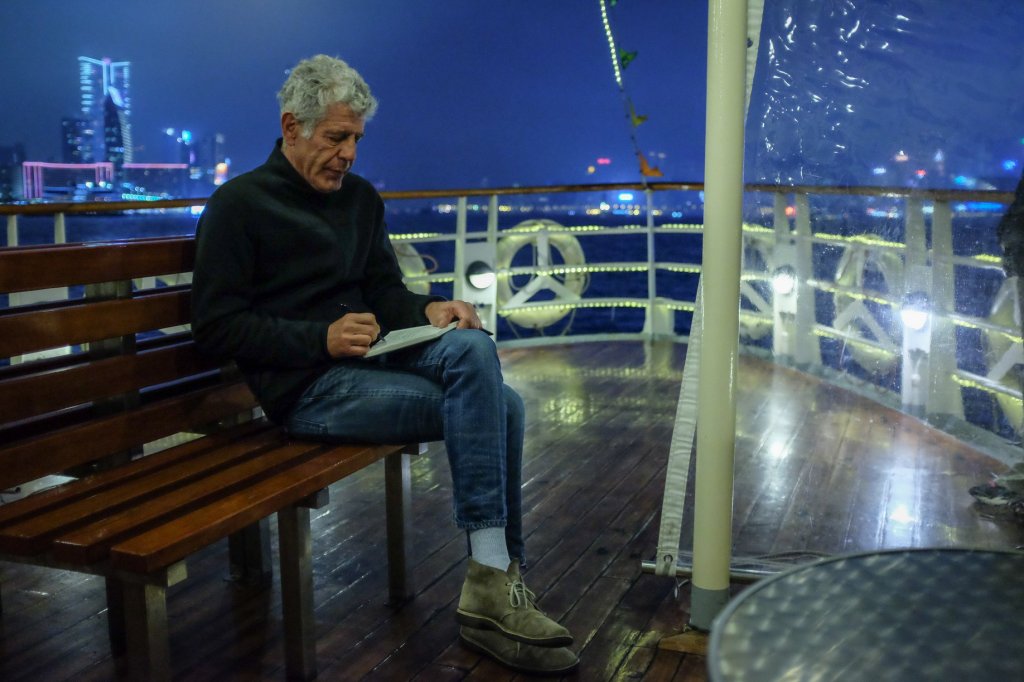
Since this is a literary blog, and in 2000 Bourdain penned that beloved tell-all book about the culinary industry which rocketed him to fame, and garnered him a handful of TV shows, I better talk about his books. . .
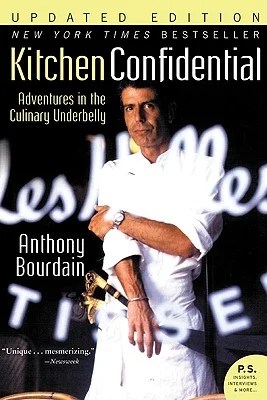
1. Kitchen Confidential: Adventures in the Culinary Underbelly: Bourdain used to joke that “Don’t order fish on Mondays” would be engraved on his tombstone. I’m happy to say that I think the world will remember him for far more than exposing the secrets of the culinary industry. In this memoir Bourdain recounts a family summer in France where he ate his first oyster, explores the fine line food straddles between the beautiful and grotesque, shows us the unsavory side of professional cooking and all of the misfits that inhabit that realm, discusses what it’s like inside the Culinary Institute of America, periods of unemployment, addiction, and how the restaurant industry thrives in the space between order and chaos. All written in that distinctive voice, and dry humor of his we loved so well on TV. While this might be Bourdain’s most popular book it’s somewhat dated, obnoxious, and jacked on testosterone. However, it’s worth reading if only to revel in the growth of Bourdain in his later books. The sections about his trip to Japan to work on the menu for the Tokyo branch of Les Halles give us a glimpse of the version of Tony that we’re more familiar with, and how visiting a foreign land not only helped him master his culinary skills on a higher level, but gave him a thirst for travel, and widened his world view.
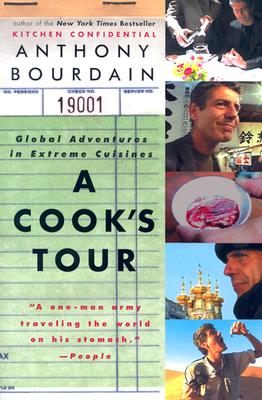
2. A Cook’s Tour: Global Adventures in Extreme Cuisines: After coming down from the high that the popularity of Kitchen Confidential gave him, Bourdain pitched a book to his publisher about traveling the globe to find the best meal in the world. Thus A Cook’s Tour was born, and was also turned into a 2 season TV Show for Food Network. We’re presented with a side of Bourdain we’re more familiar with in this book. His writing, while still gritty, is evocative and vivid. His sense of wonder about the world reels you in, and you feel like you’re right there with him on his global adventures. Bourdain explores what makes meals good. What makes them feel like magic. We follow him to Portugal where he witnesses the butchering of a pig, and in turn understands the importance of respecting ingredients, where they come from, and how they get on our plates (which wasn’t as popular among chefs in the early 2000s), to the beaches of southwest France with his brother to recreate that fateful summer where he ate his first oyster, and to Vietnam where he dines on the beating heart of a cobra for some male vitality. Through all of these adventures and much more, Bourdain comes to the conclusion that it’s simply context and memory that make a meal. Where you’re eating, and who you’re eating with can quickly become the most important factors when it comes to making or breaking a dining experience. Of course, by the end of this book the reader realizes that Tony only used the excuse of the evasive “perfect meal” to actually go on a pursuit of identity in order to grow as a person.
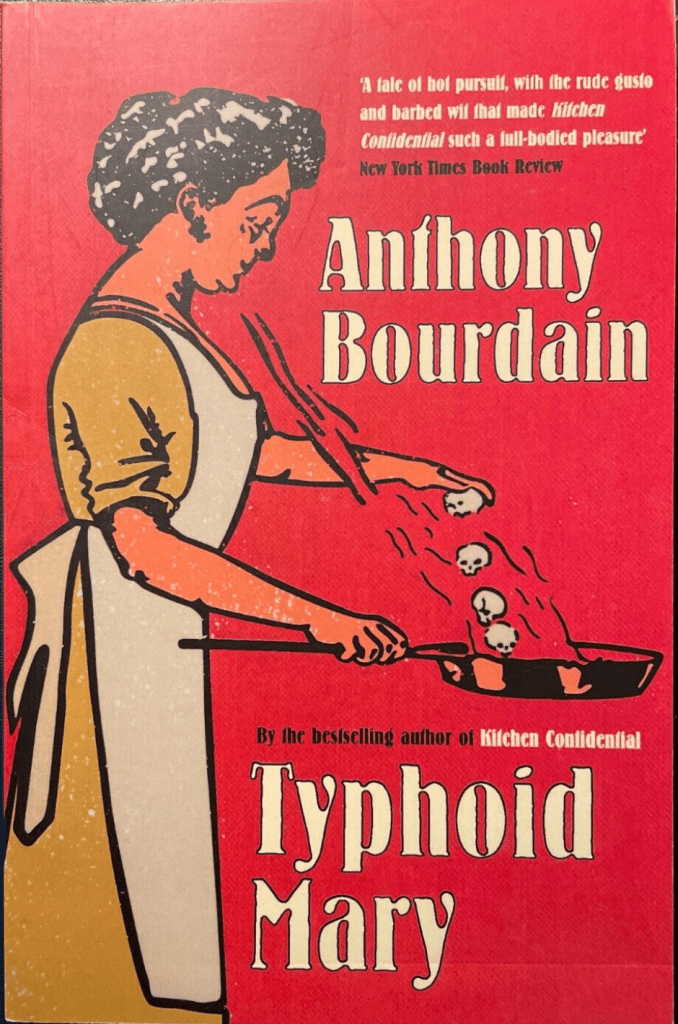
3. Typhoid Mary: An Urban Historical: This is probably one of Bourdain’s most overlooked books. Mary Mallon was an Irish immigrant who was a good cook. This allowed her to work in the kitchens of many affluent New Yorkers in the early 1900s. There was one problem though. . . she was an asymptomatic carrier of Typhoid fever. With the hand washing and heat in the kitchens, how could she have spread the disease so easily, you ask? Well, hand washing wasn’t what it is today, and one of her most famous desserts was peach ice cream. No heat required. While there are plenty of books on Typhoid Mary, Bourdain takes a different approach to her story in a way that fans of his television shows are familiar with. He helps to humanize her, and break down her troubling mythic status, through his culinary expertise in ways that those of us in the current world climate can understand. He writes of Mary Mallon’s plight, “I’m a chef, and what interests me is the story of a proud cook — a reasonably capable one by all accounts — who at the outset, at least, found herself utterly screwed by the forces she neither understood nor had the ability to control. I’m interested in a tormented loner, a woman in a male world, in hostile territory, frequently on the run.” Mary Mallon was a lowly Irish immigrant trying to navigate a new country, asymptomatic carriers were something completely new and nearly incomprehensible to consider in the 1900s, she was also a lone woman, and a victim of captivity in the name of public health. While we were in the midst of the COVID-19 pandemic, this seemed like the perfect book to read in 2020, and even made it onto my “Best of . . .” list. It certainly makes you fully understand that wearing a mask, and getting a vaccine to protect you and others from spreading a virus is small potatoes in comparison to being forcibly quarantined for three decades. We had it easy. . .
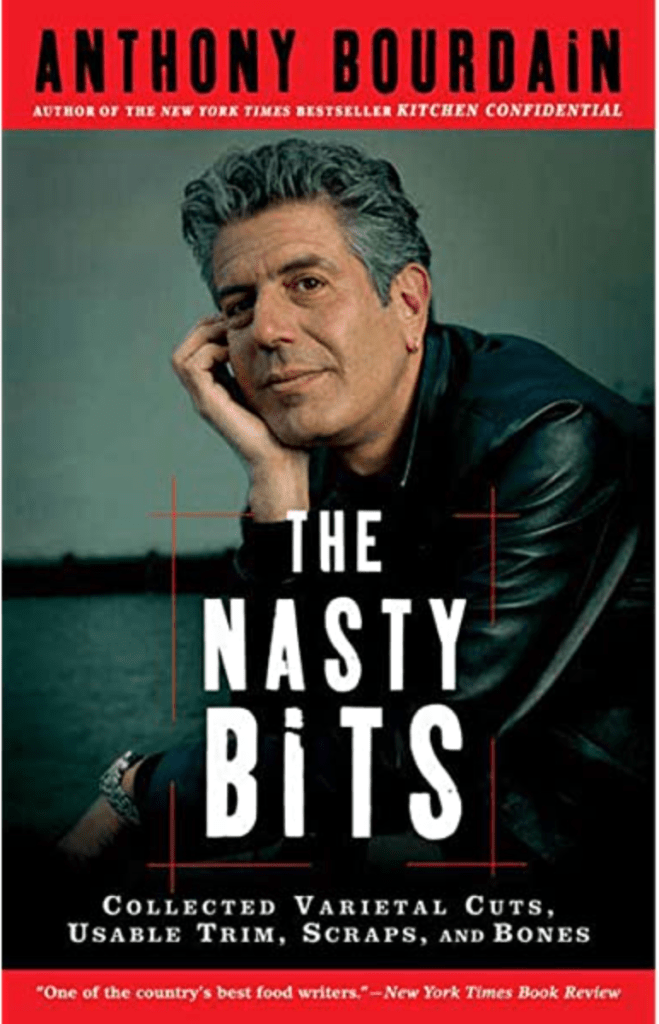
4. The Nasty Bits: Short little bites of essays that are irreverent and delightfully. . . Well, nasty. This book is a collection of articles Bourdain wrote for various publications, and his intelligent rebellion is front and center in most of them. He touches on topics including “System D” and the threshold of what cooks and chefs alike will and will not do in the kitchen during a time crunch, the evil of American fast food, the formal pomposity of fine dining, how immigrants are really the backbone of the restaurant industry yet racism keeps them in the kitchen behind closed doors, the masochistic joy of hotpot, the phenomenon of celebrity chefs, and how we all have blood on our hands in one way or another. There’s also an appendix in the back where Tony goes through each article in this collection, and admits where he was mistaken or how his opinion on the matter has changed over the years. It’s refreshing to read someone from an older generation admit when they’re wrong. Learning mixed with self-awareness doesn’t, or shouldn’t, stop when you hit middle age.
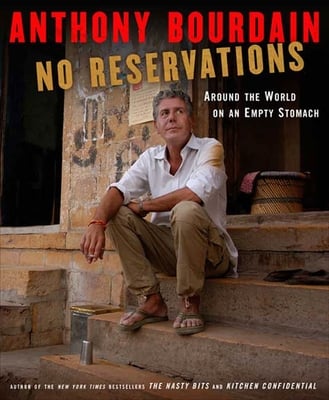
5. No Reservations: Around the World on an Empty Stomach: In the forward to this book Bourdain writes, “I’ve done my very best to not make this some cheap-ass ‘companion’ book to the series.” Well, Tony. . . you certainly succeeded in giving this book some depth, but it’s still a companion book. Filled with gorgeous photos (even the blurry, red eyed ones from those early 2000s digital cameras are beautiful in their own right), and Bourdain’s cynical yet heartfelt narrative, it gives us a glimpse behind the scenes of No Reservations. No one creates something like this solely on their own, and Bourdain is proud of his band of misfits that helped him make successful yet off brand television. We follow the crew to places like Malaysia where Tony (as guest of honor) ceremoniously killed a pig with a spear, to Beirut during a a time of unexpected unrest, and to Namibia where Tony shared a meal consisting of a whole warthog with the local bushmen. At the end of all of these adventures, and more, Bourdain brilliantly closes the book with this heart swelling statement about going home, “But maybe you do have to go home, look inward, to find some meaning in what you’ve seen of the world. Staring at my infant daughter while she sleeps, her expression changing second by second as pleasure, fear, concern, and wonder flash across her brain, I find. . . something. I’ve seen those expressions elsewhere and everywhere. Maybe the differences between places are no less — and no more — pronounced than the distance between human hearts.”
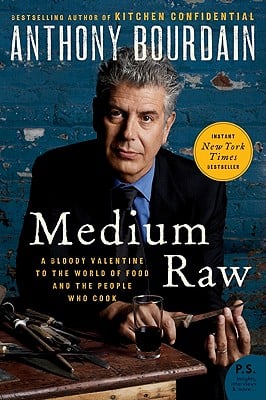
6. Medium Raw: A Bloody Valentine to the World of Food and the People Who Cook: Sort of an addendum to Kitchen Confidential, so I highly recommend reading them close together. A lot changed in Bourdain’s life between the publication of Kitchen Confidential and this book. 10 years of a life well lived (and occasionally not so well) transpired. Bourdain had become a cultural icon, entered fatherhood, gained some self awareness (At one point he writes of himself, “A loud, egotistical, one-note asshole who’s been cruising on the reputation of one obnoxious, over-testosteroned book for way too long”), and was heavily influenced by his world travel. He explores and exposes chefs and their lives after-hours, controversial food figures such as David Chang, Alice Waters, Gordon Ramsey, Jamie Oliver, and Mario Batali (although his opinions on Batali are passé after the sexual misconduct allegations), mortality, why we cook and why we want to cook well, the evils of Food Network, and what it means to “sell out.” Once again, Bourdain holds a critical lens to his previous opinions he stood so steadfastly by, and takes the shame away from admitting that you might’ve been wrong at first, but there’s always time to change what you think. It’s the same shit I’ve said about almost all of his books, but it’s true. It’s right there in print, and in the experiences Tony shared with us.
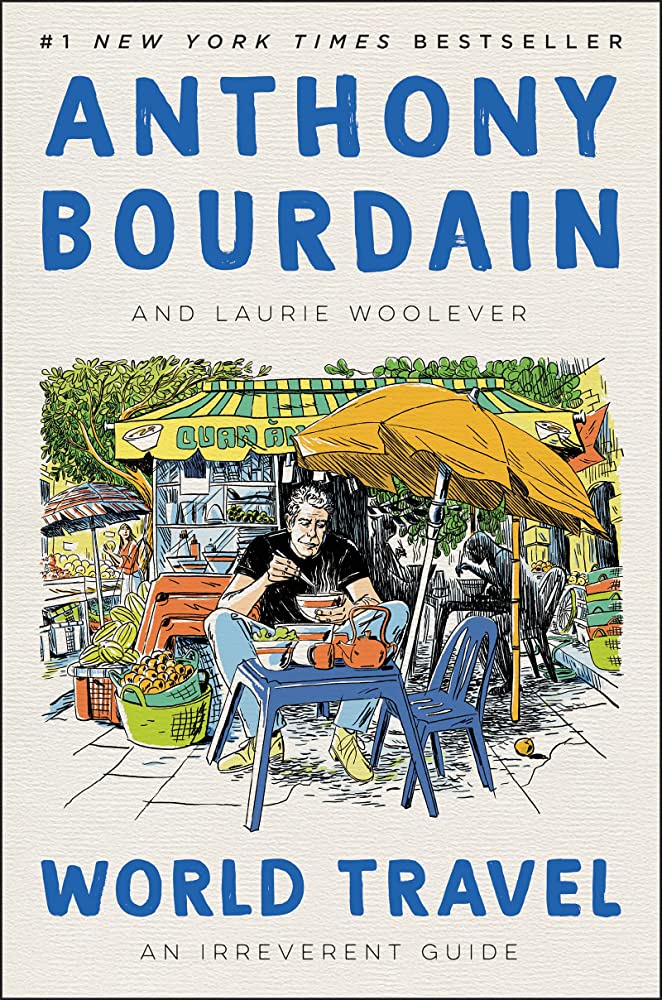
7. World Travel: An Irreverent Guide by Anthony Bourdain & Laurie Woolever: Posthumously published in 2021. Compiled by Laurie Woolever, food writer and assistant to Bourdain for years. Quotes are taken from Bourdain’s various TV shows to showcase some of the infamous world traveler’s favorite places. Woolever encouraged the help of some of those who knew Tony intimately such as his brother Chris, journalist and food writer Bill Buford, Jen Agg who is chef and owner of the now closed Black Hoof in Toronto, who gave Tony his first taste of a bone luge, and No Reservations producer Nari Kye to help complete the book. Chapters are conveniently grouped as countries in alphabetical order, have comprehensive instructions for getting from airports to city centers as well as hotels, and also include some of the dining establishments Bourdain enjoyed along the way, with helpful currency exchange rates so you know approximately how much it’ll cost in American dollars to eat what Tony ate. Calling this an “irreverent guide” might be a little too on the nose here. Since the COVID-19 is still alive and well, traveling has lost some of its appeal. When we can travel without the threat of a pandemic again, perhaps those of us who loved Tony will pick this up and find it useful. However, read in the current climate, it is hard to not find this to be just a rehash of everything we saw Bourdain do on TV, and slightly less fun to experience. Also, I wonder how many of these dining establishments in the book actually survived COVID closures by the time of publication. Originally, Bourdain was supposed to write an essay for each country in the book. He died before he got the chance. While essays from people who engaged with Tony during his lifetime actually save this book, they are few and far between.
I’m missing a few books on this list that are works of fiction/graphic novels. I found that the graphic novel medium never really allowed Bourdain’s voice to shine, and I haven’t read the standard novels yet, because one day I won’t have anything else of Bourdain’s left to read, so I’ve chosen to space them out. If you’re interested, his two most acclaimed works of fiction are a couple of crime thrillers, Bone in the Throat and Gone Bamboo.
Thank you, Tony. I hope wherever you are you’re well fed. Both in the literal and metaphorical sense. Most importantly though, I hope you’re at peace. I think the whole world is indebted to you for sharing your adventures, curiosity, and vulnerability with us. While you weren’t a perfect human by any means (Who is?) you certainly left a mark, and shamelessly advocated for admitting when you’re wrong, as well as moving and growing as much as you can no matter where you come from or where you’re going.
If you wish to celebrate Bourdain Day today and find yourself unable to travel or try new food (as most of us do these days even while vaccinated), perhaps consider doing it via a donation.
Here are a few helpful links:
The Anthony Bourdain Legacy Scholarship Fund
*This actually happened while I was on a date a few years ago. I warned this boy (who was from out of town) more than once that the people who frequented the bar we were going to would not tolerate some of the things he had to say, and that he should watch his mouth. He didn’t. I came back from greeting someone I knew at another table only to come back to the one the boy and I had occupied to a loud, hard thunk and his bleeding temple. He had had an argument with an older bar regular about how rude people from Massachusetts tend to be. I know, you do not have to point out to me how stupid this all was, and yes, I know they’re called Massholes. Although, which one was it was that was swinging glass around in the first place? Who’s really the asshole in this situation? Anyway, the boy had grown up in Massachusetts and was just sticking up for his fellow statesmen when he was whacked in the head with a bottle of Lone Star. TWICE. I didn’t really see the first contact of the bottle, but the second swing played out before my eyes in slow motion. Once the cops came they arrested not only the bottle bouncer, but my date as well. They told me he’d be charged with public intoxication. He gave me the keys to his car so I could drive it home before they cuffed him, but I had forgotten, and was immediately reminded when I sat in the driver’s seat, that I couldn’t drive it because it was a goddamn stick shift! I had to ask a stranger to take me home. To top it off, people in the bar were telling me to forget about the boy, and leave his keys under the wheelhouse for him to find when he got released the next day. I couldn’t believe the unwarranted advice I was getting. This boy had had a difficult night as it was, and yet they wanted me to leave his car vulnerable to thieves! Besides, if I had been stupid enough to leave his keys, every loudmouth in the bar would know about it by the end of the night, and I’m sure more than one of them knew how to drive stick. What if they had taken it for a joyride? While I didn’t particularly like this boy that much, I did pick him up from jail the next afternoon in my own vehicle and drove him back to his car, because that is exactly what I would have liked for someone to do for me if I was in his situation, AND because it was an act of true Southern Hospitality, y’all! It was the right and decent thing to do! I haven’t seen him since, and based on his experience I don’t think he’ll ever come back. Can you blame him? However, I hope he’s alright, doesn’t have a scar, and has learned to keep his mouth shut sometimes. Do you see what I mean about not drinking with the locals around here?
 Like Wild Onions
[…] being unaware of the majority of Lurie’s creative ventures, I was smitten. Here was Bourdain (a man who has had a significant influence on me over the years) emanating a light I hadn’t felt from him in a while, sharing some hard boiled eggs with […]
LikeLike
[…] . I’m hoping this will turn into a series, but who knows? I don’t have a crystal ball. This idea stemmed from a Bourdain post I wrote last year, so it did start out as something bookish. However, literary or not I just know that I have a lot […]
LikeLike